7 Pine Straw Mistakes Homeowners Make (And How to Avoid Them)
These 7 pine straw mistakes cost homeowners money, kill plants, and reduce weed control. Learn what landscapers see go wrong most often.
These 7 pine straw mistakes cost homeowners money, kill plants, and reduce weed control. Learn what landscapers see go wrong most often.
The Same Mistakes Show Up on Every Block
After a spring weekend, you can walk through most neighborhoods and spot the same errors. Mulch piled against tree trunks. Thin spots that'll be weedy by June. Beds that look decent from the curb but are already failing at their main job.
These aren't random failures. They're predictable mistakes that happen the same way every time. Here's the full list and how to avoid each one.
Mistake 1: Applying Too Thin
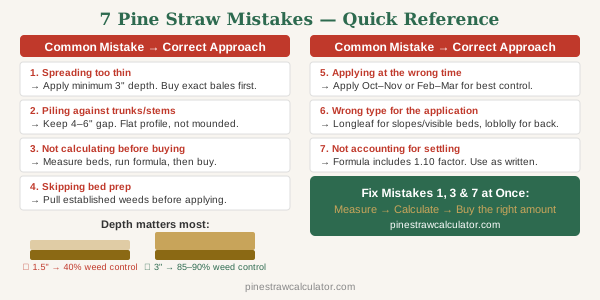
This is the most common one. You stretch your bales, trying to cover more area, and end up with 1–1.5 inches everywhere instead of 3 inches somewhere.
At 1.5 inches, you get maybe 40% weed suppression. Seeds germinate, weeds push through, and you end up hand-weeding all summer on beds that should have been protected.
The fix: commit to 3 inches as your minimum for any new application. Buy the right amount of bales before you start spreading.
How many bales do you need? The formula is: Bales = (Area × Depth ÷ 12 × 1.10) ÷ Bale Volume
For a 400 sq ft bed at 3 inches with standard bales: (400 × 3 ÷ 12 × 1.10) ÷ 2 = 55 bales
Run it through our pine straw calculator before you buy. Buying too few bales is why people end up spreading too thin.
Mistake 2: Piling Pine Straw Against Trunks and Stems
This one actually kills plants. Walk any neighborhood after mulching season and you'll see it everywhere: thick mounds of pine straw pushed up against the base of ornamental trees, like a mulch volcano.
The problem: moisture accumulation against bark. Pine straw holds water. Bark doesn't breathe well when it's constantly wet. Over months, you get crown rot, fungal disease, and an entry point for insects and rodents.
Clemson Cooperative Extension has documented tree deaths from chronic mulch-against-trunk contact within 3–5 years.
The fix: leave 4 to 6 inches of bare soil around plant stems and tree trunks. The correct mulch ring around a tree is flat or slightly concave, not mounded. Water should run toward the trunk, not away from it.
Mistake 3: Not Calculating Before Buying
Eyeballing how many bales you need usually means a second trip to the nursery. Or leftover bales you can't return. Or worst case, running out mid-job with patchy coverage that looks worse than no mulch at all.
The calculation takes 60 seconds. Measure your beds, pick your depth, run the formula. Calculate how much pine straw you need before you get in the car.
If you have multiple beds, add their square footage together and run the formula once on the total.
Mistake 4: Skipping Bed Prep
Pine straw doesn't kill established weeds. It suppresses germination and slows down seedlings, but if you have dock, thistle, or nutgrass already established in a bed, laying pine straw on top just hides the problem for 2–3 weeks.
Take 15 minutes before you apply to pull the weeds that are already there. Re-edge the beds if grass has crept in from the lawn. If you've got a serious grass problem, edge before you apply.
You also don't need to remove old pine straw before refreshing. Just loosen the top layer with a fork (it compacts and can shed water if not broken up), then add the new layer on top.
Mistake 5: Applying at the Wrong Time of Year
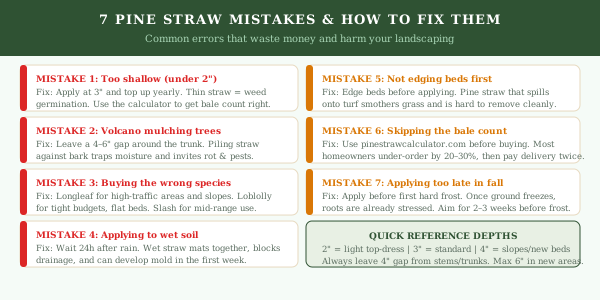
Pine straw applied in May is fighting an uphill battle. Weed seeds have already germinated. It's hot and humid. The pine straw itself won't last as long as a fall or winter application.
- The two best windows for pine straw application are:
- Late October through November: Weed seeds are dormant. You get a clean establishment before winter. Coverage looks fresh through spring.
- February through March: Before spring weed germination kicks in. Pine straw applied at this time intercepts the critical spring weed cycle.
If you apply in summer, you'll still get moisture retention and temperature moderation benefits. But weed suppression will be lower and you'll need to reapply sooner.
Read the full timing breakdown in our seasonal pine straw guide.
Mistake 6: Buying the Wrong Type for the Application
Not all pine straw is the same. Loblolly breaks down in 7–8 months. Longleaf lasts 12 months. If you buy loblolly for a high-visibility front bed expecting a full year of coverage, you'll be disappointed when it's faded and thin by October.
- The type selection depends on:
- How long you want coverage to last
- Whether you're covering slopes (longleaf's interlocking needles are much better on grades)
- Your budget (longleaf runs $6–$9/bale vs. $3–$5 for loblolly)
For high-visibility beds and slopes: longleaf or slash. For back beds and quick coverage: loblolly is fine.
Our pine straw types comparison walks through the full difference between each type, including the cost-per-year math.
Mistake 7: Not Accounting for Settling
Fresh pine straw compresses after installation. Within 2–4 weeks, your 3-inch application settles to about 2.5 inches. After the first rain, it compresses further.
The standard formula already accounts for this with a 10% settling factor. But many homeowners either: a) Don't account for it at all and end up with thinner-than-expected coverage, or b) Over-apply to compensate, then wonder why the total bale count was so high
Apply at 3 inches knowing that it'll settle to roughly 2.5 inches. That settled depth is still effective for weed suppression. You don't need to pile it thick trying to end up at 3 inches post-settling.
The 1.10 factor in the formula handles this automatically. Use the formula as written and you'll land where you need to be.
Bonus: The One Thing That Fixes Most of These
Measure before you buy. Pick your depth. Calculate your bale count.
If you start with the right number of bales, you won't spread thin. You won't make extra trips. You'll have enough material to do the job right the first time.
Get an exact bale count and you'll avoid mistakes 1, 3, and 7 automatically.
For everything else (bed prep, timing, pine straw type), you've got the guide. Do the work right and your beds will look good from now through next spring.
Our how to apply pine straw guide covers the step-by-step process in detail. And our about page explains the research and extension sources behind these recommendations.