Longleaf vs Slash vs Loblolly: Which Pine Straw Should You Choose?
Not all pine straw is the same. Longleaf lasts 12 months, loblolly just 7. Here's how to pick the right type for your beds and budget.
Not all pine straw is the same. Longleaf lasts 12 months, loblolly just 7. Here's how to pick the right type for your beds and budget.
Three Types, Three Very Different Results
Walk into a pine straw supplier and you might see bales labeled "longleaf," "slash," or just "pine straw." That last one is usually loblolly: the cheapest option, and the one that breaks down fastest.
The type you choose affects how long it lasts, how much you'll spend over time, and how it looks in your beds. Here's exactly what you need to know about each.
Longleaf Pine Straw
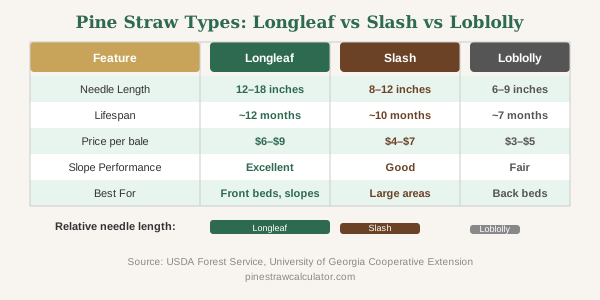
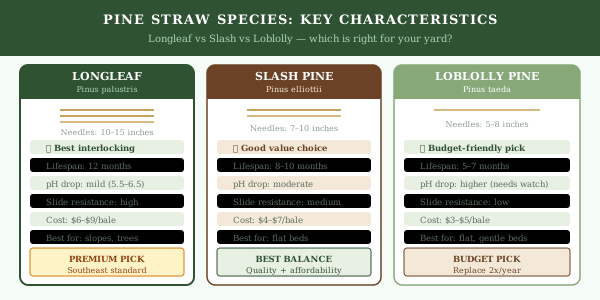
Longleaf pine (Pinus palustris) produces needles that are 12–18 inches long. That length is what makes it special.
Longer needles knit together tightly. The result is a dense mat that holds its position on slopes, resists wind displacement, and breaks down slowly. Under normal conditions, a properly applied layer of longleaf pine straw lasts about 12 months before you need to refresh it.
It's also the best-looking option. Fresh longleaf has a warm amber-brown color with a slight sheen. Even after it fades, it looks more finished than other types.
The trade-off: Longleaf is the most expensive pine straw you'll buy. Expect to pay $6 to $9 per standard bale, depending on your region and supplier. In areas where longleaf forests are less common (parts of Georgia's piedmont, Virginia), prices run toward the higher end.
If your beds are visible from the street and you want to go 12 full months between applications, longleaf is worth the extra cost.
Slash Pine Straw
Slash pine (Pinus elliottii) needles run 8 to 12 inches long, shorter than longleaf but still longer than loblolly. It's the middle-ground option in every way: cost, durability, appearance.
A good layer of slash pine straw lasts around 10 months. You'll typically need to refresh it once a year, just slightly sooner than longleaf. The color is similar (reddish-brown when fresh), but it doesn't knit as tightly, so it has slightly less wind resistance.
Price: $4–$7 per standard bale. For most homeowners mulching large areas, slash is the practical choice. You get good coverage, decent longevity, and you're not paying longleaf prices on backyard beds that nobody sees from the street.
Slash is widely available across Florida, Georgia, and the Carolinas. If your local nursery just says "pine straw" without specifying type, ask. It's often slash or a mix of slash and loblolly.
Loblolly Pine Straw
Loblolly pine (Pinus taeda) is the most common pine tree in the Southeast. It's fast-growing, abundant, and produces shorter needles, usually 6 to 9 inches long.
Those short needles don't interlock as well. Loblolly breaks down faster than other types, lasting roughly 7–8 months under typical conditions. In humid climates with regular rain, you might be refreshing it after just 6 months.
Price: $3–$5 per standard bale. It's the cheapest option, and for quick coverage of back beds or areas where longevity doesn't matter, it works fine.
Where loblolly falls short: slopes, windy areas, or anywhere you want a full 12 months between applications. The short needles shift, thin out, and decompose before you're ready.
A Real Cost Comparison
Let's say you've got 800 sq ft of beds to cover at 3 inches deep. Using our pine straw calculator, that works out to:
(800 × 3 ÷ 12 × 1.10) ÷ 2 = 110 standard bales
Here's what each type costs for that job, and over two years:
| Type | Price/bale | Job cost | Replacements in 2 yrs | 2-year total |
|---|---|---|---|---|
| Longleaf | $7.50 avg | $825 | 1x (month 12) | $1,650 |
| Slash | $5.50 avg | $605 | 2x (months 10, 20) | $1,815 |
| Loblolly | $4 avg | $440 | 3x (months 7, 14, 21) | $1,760 |
Longleaf actually comes out cheapest over two years in this example. That's the math most homeowners miss when they grab the cheap bales.
Which Type Is Right for You?
- Buy longleaf if:
- Your beds are front-facing or high-visibility
- You have slopes that need the needles to stay put
- You want to apply once and forget it for a full year
- Your budget can handle the higher upfront cost
- Buy slash if:
- You're covering large areas and cost matters
- You're in Florida or coastal Georgia where slash is the dominant local supply
- You want a good balance of price and longevity
- Buy loblolly if:
- You're filling in back beds that don't get much attention
- You need a quick, cheap fix for a rental property or staging
- You'll be refreshing frequently anyway (say, twice a year)
You can also mix types. Use longleaf in visible front beds and loblolly in backyard areas. Suppliers usually don't mind mixing an order.
How to Tell Them Apart at the Store
The easiest way: grab a needle bundle and measure. Longleaf needles are noticeably long, and often hang over the edge of the bale. Loblolly is short and compact. Slash falls in the middle.
Color-wise, freshly harvested longleaf often has a slightly richer, more golden tone compared to loblolly's more muted brown. But once bales have been sitting outside for a few weeks, the difference is harder to see.
If the bale is unlabeled, ask the supplier directly. A reputable dealer knows what they're selling.
Calculating Your Bales
No matter which type you choose, the calculation is the same. The formula is:
Bales Needed = (Area × Depth ÷ 12 × 1.10) ÷ Bale Volume
Standard bales are 2 cubic feet. Large bales are 3. Rolls are 5.
For a 300 sq ft bed at 3 inches deep with standard longleaf bales: (300 × 3 ÷ 12 × 1.10) ÷ 2 = 41.25 → buy 42 bales
You can run the numbers yourself with this pine straw bale calculator. Plug in your area, depth, and bale size and it handles the math.
The Long Game
Cheap pine straw isn't always cheap. When you factor in labor time for reapplication (even just your own time on a Saturday), loblolly's lower price per bale looks less attractive.
For beds you care about, longleaf or slash is usually the better investment. For everything else, buy what's available and refresh when it looks thin.
Read more about timing your applications in our seasonal pine straw guide, and see our about page for information on the sources behind our recommendations.