Pine Straw vs Wood Mulch: Which Is Better for Your Yard?
Pine straw or wood mulch? The choice affects your cost, weed control, and plant health. Here's what contractors actually recommend for Southeast yards.
Pine straw or wood mulch? The choice affects your cost, weed control, and plant health. Here's what contractors actually recommend for Southeast yards.
The Question Homeowners Ask Every Spring
Walk into any garden center in April and you'll see both piled high: bales of pine straw stacked near the entrance, bags of shredded hardwood mulch nearby. Both do the same basic job. But they're not interchangeable.
After seeing both used on thousands of jobs, there are real differences worth knowing before you spend a dollar.
What Each One Actually Does
- Both pine straw and wood mulch:
- Suppress weeds by blocking sunlight
- Retain soil moisture
- Moderate soil temperature
- Add organic matter as they break down
The differences are in how well they do each job, how long they last, and what they cost.
Coverage and Cost
Let's talk numbers first, because this is where people get surprised.
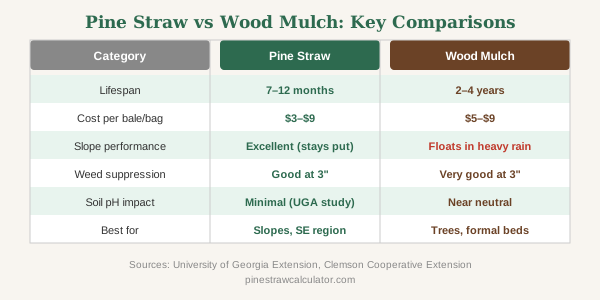
A standard pine straw bale covers about 8 sq ft at 3 inches deep and costs $4–$9 depending on type (longleaf runs higher, loblolly lower). A 2-cubic-foot bag of shredded hardwood mulch covers roughly the same area and runs $5–$9 at retail.
On a per-coverage basis, they're close. But pine straw often wins on bulk orders. A landscaper buying 200 bales of longleaf might pay $5 each, covering 1,600 sq ft for $1,000. The same area in bagged hardwood mulch would run $1,200 to $1,500 at retail.
For big jobs, get an exact bale count before you call your supplier. Knowing exactly how many bales you need puts you in a better spot when negotiating bulk pricing.
How Long Each Lasts
This is the biggest practical difference.
Wood mulch: Good-quality shredded hardwood lasts 2–3 years in most climates. Bark nuggets can last 3–4 years. Dyed mulch fades faster (usually within a season). It breaks down slowly, which is great for long-term weed suppression.
Pine straw: Longleaf pine straw lasts about 12 months before it needs refreshing. Slash pine is around 10 months. Loblolly (the cheapest and most common) breaks down in 7 to 8 months. You're reapplying every year, sometimes twice.
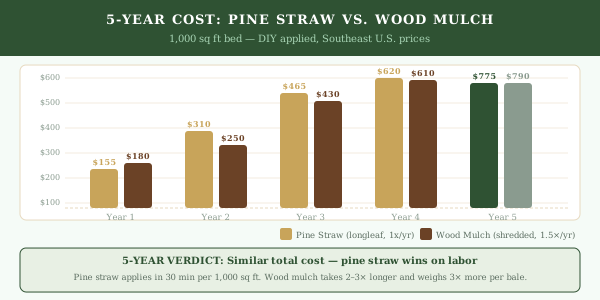
That annual refresh cost adds up. On a 500 sq ft bed, you might spend $60 to $80 in pine straw per year versus $40 to $60 every two or three years in wood mulch. Over a five-year stretch, wood mulch is often cheaper overall, though pine straw is cheaper upfront.
How They Handle Rain and Slopes
Here's where pine straw has a clear advantage: it doesn't wash away.
Wood mulch floats. Heavy rain on a sloped bed moves mulch around, piles it against fence posts, washes it into the lawn. You'll be redistributing it after every hard storm.
Pine straw knits together as it settles. The needles interlock and hold their position on slopes. On a 30-degree grade, pine straw stays put. Wood mulch on that same grade is a maintenance headache.
If you have any sloped beds or areas that drain toward your lawn, pine straw is the practical choice.
 You can also layer it heavier on slopes (up to 4 inches) without worrying about it washing. Our pine straw depth guide covers slope applications in detail.
Soil Acidity: The Big Myth
You've probably heard that pine straw makes soil acidic. It's one of the most repeated claims in gardening, and it's mostly wrong.
Fresh pine needles are slightly acidic. But by the time they've dried and been baled, that acidity is largely gone. Multiple university extension studies, including work from the University of Georgia and Clemson Cooperative Extension, have found that pine straw has minimal effect on soil pH under typical application rates.
Wood mulch from hardwoods is close to pH-neutral. Cedar and cypress mulch can actually have mild antimicrobial properties that affect soil biology.
Neither product dramatically changes your soil pH in a single season. If you're worried about acidity, test your soil first. Don't make a buying decision based on this myth.
Plant Compatibility
Both materials work fine around most shrubs, perennials, and trees. A few specifics:
- Pine straw is better for:
- Azaleas, gardenias, and other acid-loving plants (it won't hurt them, and the slight acidity in fresh needles is a minor bonus)
- Strawberries and low-growing perennials (doesn't compact, good airflow)
- Slopes and erosion-prone beds
- Native plantings in the Southeast where pine straw is the natural ground cover
- Wood mulch is better for:
- Vegetable gardens (breaks down faster, adds more nutrients)
- Trees (bark mulch around trees is ideal because it mimics the forest floor)
- Areas where you want a more formal, finished look
- Beds where you're planting annuals frequently (easier to dig through)
For vegetable gardens specifically, the choice gets more nuanced. You can read the full breakdown in our pine straw for vegetable gardens post.
Appearance
This one is subjective, but it matters.
Fresh pine straw has a warm reddish-brown color that looks natural in Southern and cottage-style gardens. It fades to gray after several months, which is when most people apply a fresh layer.
Dyed wood mulch (the red, black, and brown varieties) holds color better through the first season. By year two, it fades regardless of the dye. Natural shredded hardwood goes gray-brown over time, similar to weathered pine straw.
Bark nuggets and decorative stone look more finished and last longer, but cost significantly more.
The Bottom Line: Which Should You Choose?
- Choose pine straw if:
- You're in the Southeast where longleaf and slash pine are readily available
- You have slopes or erosion concerns
- You want lower upfront cost and don't mind annual refresh
- You're mulching acid-loving plants
- Choose wood mulch if:
- You want to go 2–3 years between applications
- You're mulching around trees or in formal beds
- You're working in a vegetable garden
- Wood mulch is significantly cheaper in your area
Many homeowners use both. Pine straw on slopes and foundation beds, wood mulch in the vegetable garden and around specimen trees. It doesn't have to be one or the other.
Before you buy either, measure your beds and calculate how much pine straw you need. The math works the same way for wood mulch. Knowing your exact quantity prevents overspending and avoids the mid-project supply run.
Our about page has more on how we put this calculator together and the sources behind our recommendations.