How Landscaping Contractors Estimate Pine Straw: Job Pricing Guide
Landscaping contractors use a specific formula to estimate pine straw jobs. Here's how pros calculate bales, price labor, and build winning quotes.
Landscaping contractors use a specific formula to estimate pine straw jobs. Here's how pros calculate bales, price labor, and build winning quotes.
How Contractors Actually Price These Jobs
A homeowner calls for a quote on pine straw installation. An experienced contractor can estimate the job in under 5 minutes: bale count, labor hours, material cost, final number. If you're a contractor, this is that process. If you're a homeowner, this is how the number on that quote is built.
Either way, understanding the math helps you make better decisions.
Step 1: Measure the Job
Contractors don't eyeball square footage. They walk the property with a measuring wheel or a tape measure and document every bed.
- The measurement process:
- Walk each bed and record length × width
- For irregular shapes, break into rectangles and add them
- Note anything that changes material requirements: slopes (use more), tree root zones (deeper application), problem weed areas (full 4-inch depth)
- Total up all square footage before calculating anything
On a typical residential job with 5–6 beds, this takes 10–15 minutes. On a large commercial property, budget 30–45 minutes for measuring alone.
Step 2: Calculate Bale Count
The formula every contractor uses:
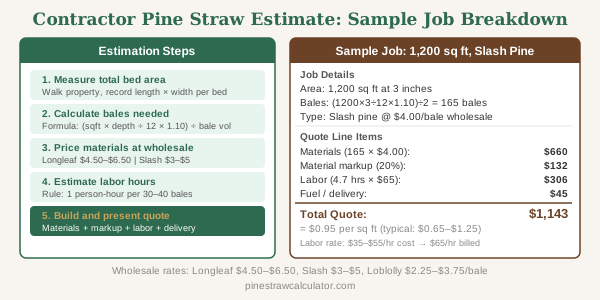
Bales = (Total Square Footage × Depth in Inches ÷ 12 × 1.10) ÷ Bale Volume
The 1.10 is the settling factor. Never skip it. Pine straw compresses after installation, and clients will notice if their beds look thin two weeks after a fresh application.
Example job: Residential property with 1,200 sq ft of beds, standard 3-inch depth, standard bales (2 cu ft):
(1,200 × 3 ÷ 12 × 1.10) ÷ 2 = 165 bales
Want to run this faster on-site? Our pine straw calculator handles any combination of area, depth, and bale size in seconds. Many contractors use it between measuring and writing the quote.
Step 3: Determine Material Cost
- Contractors don't pay retail. Wholesale supplier pricing for landscaping contractors:
- Longleaf: $4.50–$6.50 per bale (vs. $6–$9 retail)
- Slash: $3.00–$5.00 per bale (vs. $4–$7 retail)
- Loblolly: $2.25–$3.75 per bale (vs. $3–$5 retail)
Many suppliers offer tiered pricing. At 100 bales, you get one rate. At 500, another. At 1,000+, a significantly lower rate.
For the 165-bale example job using slash pine straw at $4.00/bale: 165 × $4.00 = $660 in materials
Some contractors add a 15 to 25 percent material markup over their cost when billing clients. Others price materials at market rate and make margin on labor. Both approaches work; what matters is consistency in your quoting.
Step 4: Estimate Labor Hours
- The rule of thumb most experienced crews use: 1 person-hour per 30–40 bales, depending on:
- Bed accessibility (tight gates, narrow paths = slower)
- Distance from vehicle to beds (long haul = slower)
- Terrain (slopes are 20–30% slower)
- Crew experience
For 165 bales with good access and flat terrain: 165 ÷ 35 = 4.7 person-hours
One experienced person: 4.7 hours solo. Two-person crew: 2.4 hours (with one person handling bale transport and one spreading, you get close to true halving).
Most residential pine straw jobs run 2–5 crew hours. Commercial properties with 500+ bales can run a full crew day.
Step 5: Price the Labor
Landscaping labor rates vary by region. Current going rates in the Southeast:
- Solo operator: $55–$80/hour (billing rate for the business)
- Crew labor: $35–$55 per person per hour billed to client
For 4.7 person-hours at $65/hour: $306 in labor
Your actual labor cost is significantly lower. If you're paying crew at $18 per hour, 4.7 hours equals $84.60 in wages. Your margin comes from the gap between cost and billing rate.
Step 6: Build the Quote
Components of a complete pine straw quote:
| Item | Amount |
|---|---|
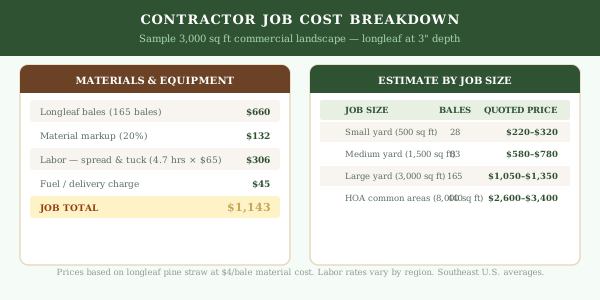
| Materials (165 bales × $4.00) | $660 |
| Material markup (20%) | $132 |
| Labor (4.7 hrs × $65) | $306 |
| Fuel/delivery | $45 |
| Total | $1,143 |
Rounded to $1,150 for the client.
That's $0.96 per square foot on a 1,200 sq ft job, well within the typical residential range of $0.65 to $1.25 per sq ft for supply and install.
Large jobs (2,000+ sq ft) often price below $0.80/sq ft due to efficiency. Small jobs (under 400 sq ft) often price above $1.00/sq ft because minimum visit charges apply.
Handling Different Bale Types in Estimates
When clients ask about longleaf vs. loblolly, the cost difference in contractor pricing is real but smaller than retail:
- For the same 1,200 sq ft job:
- Loblolly at $3.00/bale: Materials = $495, total estimate ~$975
- Slash at $4.00/bale: Materials = $660, total estimate ~$1,150
- Longleaf at $5.50/bale: Materials = $908, total estimate ~$1,400
The pitch to clients: longleaf at $1,400 once per year vs. loblolly at $975 twice per year. Longleaf wins at $1,400/year vs. $1,950/year for two loblolly applications.
This is a conversation worth having with clients. It positions you as an advisor, not just a laborer. And it typically closes the longleaf upsell.
Using Technology for Faster Estimating
Field estimating tools have made quoting faster. A few workflows that work:
Phone calculator + our tool: Measure beds, enter square footage into this pine straw bale calculator while standing at the property, screenshot the result, build the quote in your truck.
Area measurement apps: Apps like Google Maps or Measure (iOS) can get you rough square footage on large properties before a site visit. Never quote without confirming on-site, but it helps with phone inquiries.
Templates: Build a simple spreadsheet with your material costs and labor rates. Once you have bale count from the calculator, everything else flows automatically.
Common Estimating Mistakes Contractors Make
Underestimating haul distance. Walking 200 feet round-trip per bale adds up fast. A 50-bale job with a 200-foot haul is 10,000 feet of walking. Factor it in.
Forgetting bed prep time. Edging, pulling weeds, and cleaning up before you even open a bale takes time. A bed that needs significant prep adds 30–45 minutes to a typical residential job.
Not accounting for slopes. Sloped beds take 20 to 30 percent longer to cover properly. They also require more material because you need 4 inches on most slopes instead of 3. That's a 33% increase in bale count.
Using retail pricing to estimate material cost. If you're quoting based on what Home Depot charges, your material line is wrong. Know your wholesale rates.
Subcontracting vs. Crew Work
Some contractors subcontract pine straw installation to specialty crews. This is common in Florida and Georgia where pine straw crews work exclusively on high-volume installation.
Subcontractor rates for pine straw installation (labor only, contractor provides materials): $0.25–$0.40 per sq ft, or $1.50–$2.50 per bale installed.
For a 165-bale job at $2.00/bale subcontracted: $330 in sub labor. If you're charging the client $306 in labor... that math doesn't work. Subcontracting makes sense on very large jobs (500+ bales) where you don't have available crew.
The Client Conversation About Timing
Savvy contractors bring up application timing as part of the estimate. If a client calls in July asking for pine straw, the honest answer is: you can do it now, but a November application will give you better weed control and longer coverage.
Offering to schedule the job and take a deposit for fall installation builds trust and fills your calendar. It also leads to a better result, which means repeat business. Our seasonal application guide has the region-by-region timing data to back this up.
Getting Your Numbers Right
Whether you're running 2 jobs a week or 20, accurate estimates start with accurate bale counts. Calculate how much pine straw you need before you write any quote, and your materials line will always be right.
For more on pine straw types and which to recommend to clients, see our longleaf vs. slash vs. loblolly comparison. And the about page has the background on the sources and data behind our recommendations.