How Much Pine Straw Do I Need? A Simple Calculation Guide
Wondering how much pine straw you need? Use the simple square footage formula to get an exact bale count before you buy.
Wondering how much pine straw you need? Use the simple square footage formula to get an exact bale count before you buy.
Stop Guessing at the Home Improvement Store
You've been there. You grab a few bales, spread them out, and realize you're short. So you make a second trip. Then a third. By the time you're done, you've wasted half a Saturday and spent $20 more than you needed to.
Pine straw math isn't complicated. It just takes a few numbers and 30 seconds. Here's exactly how to do it.
The Formula (It's Simpler Than It Looks)
Here's the formula landscapers use on every job:
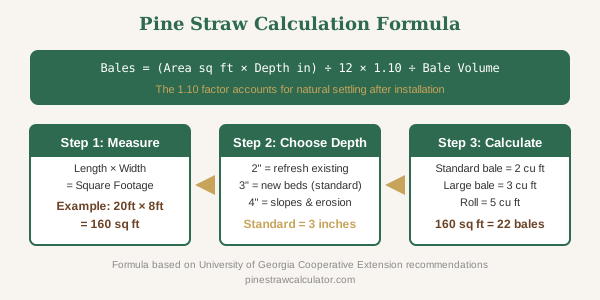
Bales Needed = (Area in sq ft × Depth in inches ÷ 12 × 1.10) ÷ Bale Volume
That 1.10 multiplier accounts for settling. Pine straw compresses after it's spread and after the first rain. If you don't add 10%, you'll end up thin in spots by week two.
- Bale volumes by type:
- Standard bale: 2 cubic feet
- Large bale: 3 cubic feet
- Roll: 5 cubic feet
Most homeowners buy standard bales. Large bales make sense if you're covering more than 2,000 sq ft.
A Real Example
Say you've got a front bed that's 20 feet wide and 8 feet deep. That's 160 sq ft. You want a 3-inch layer, the standard for weed control.
160 × 3 ÷ 12 × 1.10 ÷ 2 = 22 standard bales
That's it. You'd buy 22 bales and have just a little left over for touch-ups.
Want to skip the math? Use our pine straw calculator and get the number in seconds.
Why Depth Matters More Than Area
Most people focus on square footage and ignore depth. That's backwards.
A 2-inch layer uses 67% as much material as a 3-inch layer. On a large job, say 1,000 sq ft, that difference is 18 bales. At $5 each, that's $90. Getting depth right saves real money.
- For most beds, you want:
- 2 inches: existing beds with good coverage being refreshed
- 3 inches: new beds or thin spots that need weed suppression
- 4 inches: slopes or erosion-prone areas
Going past 4 inches isn't useful. It can actually trap moisture against plant stems and cause rot. More isn't better here.
You can read more about depth choices in our pine straw depth guide.
Measuring Your Beds
You don't need anything fancy. A 25-foot tape measure from the hardware store works fine. Measure length and width, multiply them, and you've got square footage.
For irregular shapes, break them into rectangles. Measure each rectangle separately, add them up. If you've got a curved bed, measure it at its widest and longest points and you'll be close enough.
Don't forget to measure all your beds, not just the front yard. People often calculate the front, buy bales, then realize they also need to cover the foundation beds on the sides of the house.
How Many Square Feet Per Bale?
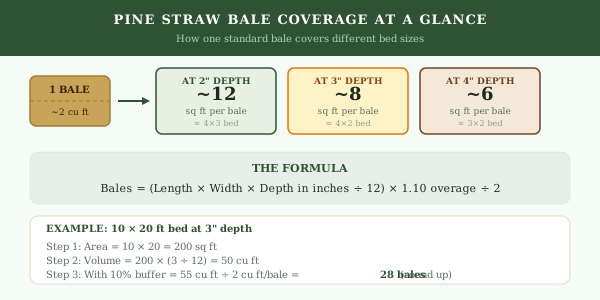
At 3 inches deep, a standard bale covers roughly 8 square feet. That's the rule of thumb most landscapers use for quick estimates.
So if you have 400 sq ft to cover, you'd need about 50 bales as a quick estimate. The formula gives you a more precise number: 55 bales after accounting for settling.
Buying the Right Amount
Always round up by one or two bales. Pine straw is cheap. Running out mid-job and having patchy coverage costs you time and looks bad.
Also check whether your supplier sells by the bale or the bundle. Some nurseries bundle 5 bales together, which makes the math easy: 10 bundles of 5 gives you 50 bales.
If you're ordering delivery, minimums often start at 50 to 100 bales. That's worth knowing before you get a quote.
Calculating for Multiple Beds
Most yards have several separate beds. The easiest approach: measure each bed, record the square footage on your phone, add them up, then run the formula once on the total.
- Example:
- Front foundation bed: 240 sq ft
- Mailbox island: 40 sq ft
- Side bed: 120 sq ft
- Backyard border: 300 sq ft
Total: 700 sq ft at 3 inches = (700 × 3 ÷ 12 × 1.10) ÷ 2 = 96 standard bales
That'd take about 3 hours for one person with a wheelbarrow. Plan your Saturday accordingly.
Should You Order Extra?
If you're putting down pine straw for the first time in a bed, order 10% extra beyond what the formula says. New installations tend to run a little thin around the edges and near plant bases where you're working carefully.
For refreshing existing beds, the formula is usually spot-on.
Our about page explains more about how this calculator was built and the extension research it's based on.
What About Pine Straw Rolls?
Rolls cover more area per unit. A single roll holds 5 cubic feet, compared to 2 for a standard bale. They're faster to spread on long, straight beds.
The formula still works the same way. Just swap in 5 for bale volume.
For a 300 sq ft bed at 3 inches deep: (300 × 3 ÷ 12 × 1.10) ÷ 5 = 16.5 rolls, so buy 17.
Rolls are less common at retail nurseries but easy to find at wholesale suppliers. They're worth it if you're covering more than 1,500 sq ft.
The Bottom Line
Pine straw math is easy once you've done it once. Measure your beds, pick your depth, run the formula. Estimate your bales needed before you leave the house, and you won't be making a second trip.
If you're comparing pine straw to other mulch options before you buy, check out our pine straw vs wood mulch comparison to see which makes more sense for your yard.